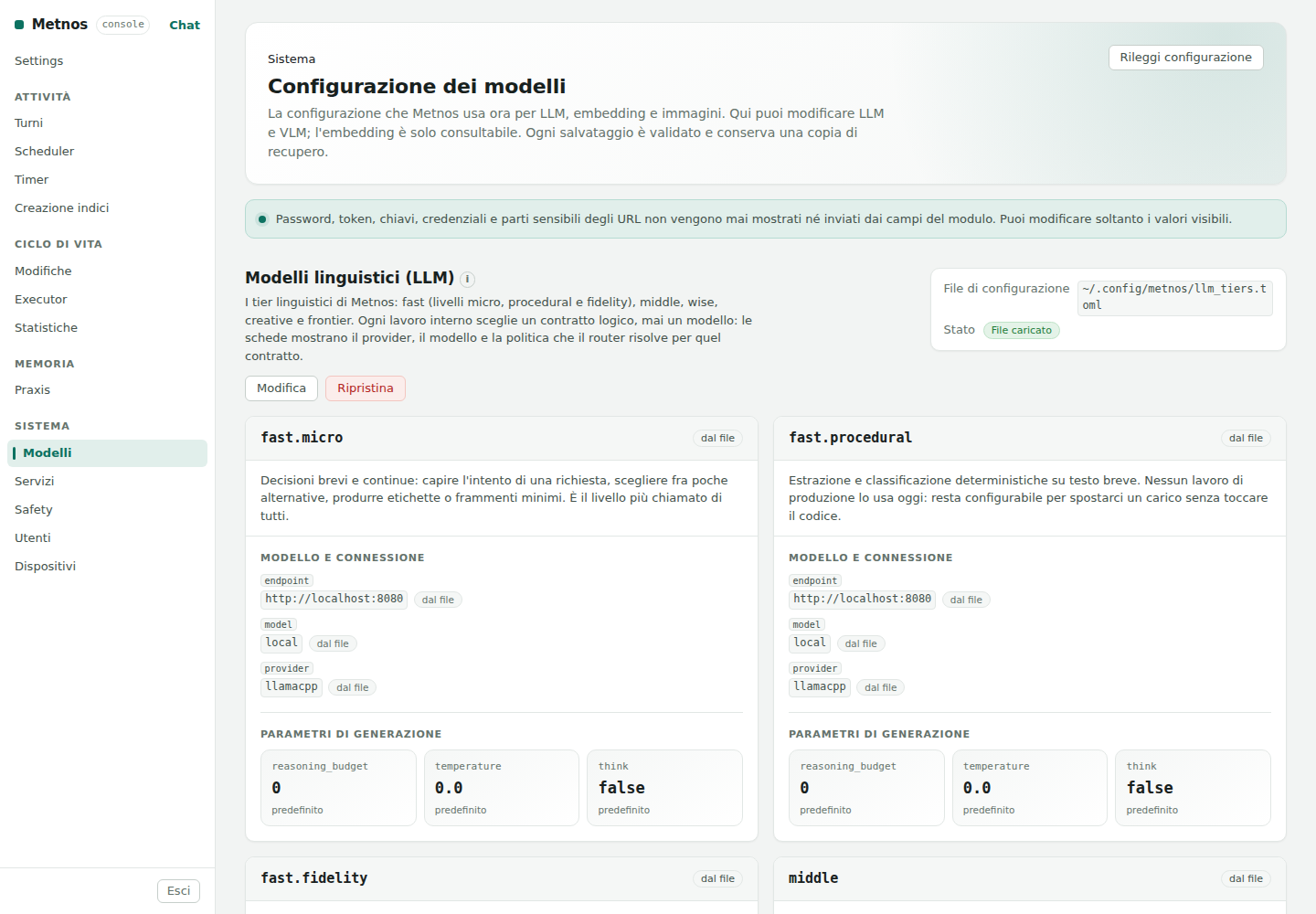
Metnos assigns requests through functional contracts, not by the name of a specific model. Each activity declares the capability it needs; the instance configuration then binds that contract to a model and provider that are actually available. The code therefore remains independent of individual implementations, and every substitution can be reviewed.
| Tier | Intended use |
|---|---|
fast.micro | Very short decisions, a choice among a few alternatives, and minimal labels. |
fast.procedural | Deterministic extraction and classification of short text, when configured. |
fast.fidelity | Faithful transformation of long text without creative additions. |
middle | Classification, structured extraction, and intermediate evaluation. |
wise | Planning, synthesis, and deliberative work for which overall quality is the priority. |
creative | Variants, proposals, and exploratory wording; it is the only tier deliberately configured for greater variation. |
frontier | Explicit, optional use of a highest-capability remote model, never a silent fallback for ordinary production work. |
The creative tier is not more precise; its purpose is to produce
alternatives. Metnos favours low-variation contracts for faithful or verifiable
work. The frontier tier may use external resources and must be
configured explicitly.
Local image and face models must remain available when Metnos changes
release. Their shared directories can be set with model_dir in
the [image] and [face] sections of
embedding_tiers.toml; the face provider is face.
These settings select model data, not executable programs. An executor can
read only the model files allowed by its contract. A missing model is not
downloaded silently and prevents the affected analysis from completing.
The page can edit LLM and VLM configuration and restore the previous version. Before saving, Metnos validates the structure and values and retains a recovery copy. Passwords, tokens, credentials, and sensitive URL components are neither exposed nor transmitted through form fields; the interface changes visible values only.
Changing a model does not increase Metnos's authority. Executors, policy, user identity, and budgets still determine whether an action is admissible. LRE also records the model binding in its revision, so an incompatible change must not silently mix results produced under different configurations.
The local path is abbreviated in the image. Structure and labels come from the real web interface.